Human Rights Leadership and the Challenge of Securing Justice in Brazil
Leading on a fault line.
12/13/20252 min read


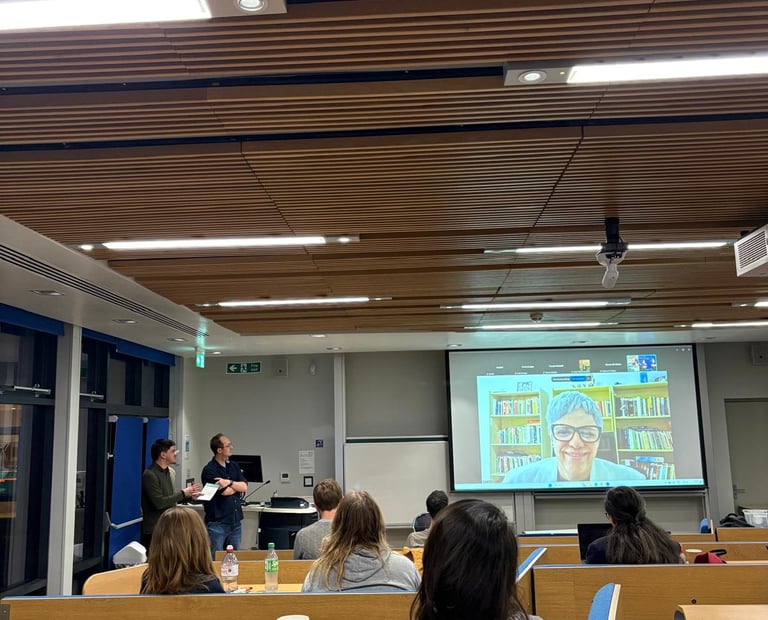
The work of human rights leaders is a daily struggle against political resistance, historical erasure, and structural inertia. At York, we recently hosted a special guest, Professor Enea de Stutz e Almeida, for a discussion on Brazil's post-dictatorship justice process.
Enea was President of the Brazil's Amnesty Commission, which provides reparations to victims of the country’s military dictatorship (1964-1985). The discussion laid bare the sheer weight of the systemic challenges faced by leaders and practitioners in securing justice for victims of the dictatorship, and how human rights struggles are rarely simple but rather waged over decades.
Effective leadership
One of the greatest sources of inertia in securing justice for victims stems from the fact that the military retained significant power behind the scenes following the transition to democracy. The 1979 amnesty law, which remains in effect today, is a major obstacle: the law allowed some political exiles to return to the country while also providing perpetrators of violence immunity from prosecution. For human rights in places like Brazil, leaders and practitioners have led for decades on a fault line, where entrenched political and economic interests actively resist change. Effective human rights leadership must be politically astute and capable of mapping and manoeuvring against these the visible and less visible power structures.
Working from the bottom-up
As scholars like Gisele Lecker de Almeida have argued, the rise of the far right and populism in Brazil (and the phenomenon of Bolsonaro) is, in part, a consequence of the failure of transitional justice mechanisms to properly embed a human rights culture. What’s highlighted again is the widespread lack of public knowledge about the dictatorship's past, and the indifference of a large part of the population to Bolsonaro’s statements in favour of the dictatorship. This is a failure of memory work. Moreover, our discussion in York highlighted the limited ways in which victimhood has been conceptualised within transitional justice processes (as direct political opponents of the regime) the need to recognise other victims, like indigenous peoples; and the disconnect between memory work and how ordinary people experience Brazil’s democracy.
These are key challenges for human rights leaders: how do you design justice mechanisms and do memory work from the bottom-up? The solutions can't remain confined to elite legal and academic circles; they must be designed to resonate with, empower, and support the lived experiences of the wider population.
We considered the path ahead: while an overturning of the 1979 Amnesty Law next year will be a significant turning point if successful, justice work must remain adaptive, politically savvy, and focused on shifting deep cultural foundations.