Human Rights Practice, Virtues and the ‘Character Gap’
Some reflections on character and ethics.
6/18/20262 min read


This week we finished delivering a training workshop for masters level students on the theme of leadership in time of crises. There were multiple themes in the curriculum, and I’d have enjoyed engaging the students in the topic for the remainder of the week (indeed, one of the participants recommended we extend it next time!).
One of the themes we could have spent several days on is practitioner strengths and virtues. There’s little I can see happening in this space within the human rights sector, specifically how strengths can be exercised and cultivated in and through practices (in the MacIntyrean sense).
Character and virtue also feature within approaches to normative ethics. In human rights, most of the work on ethics seems to be written by academics offering cases related to academic research, with comparatively little examined from the vantage point of e.g. human rights fact-finding, testimonial inquiry, civic action. I wonder if this begins to explain one part of the ‘character gap’ i.e. that social scientists, bringing (their more familiar) deontological and utilitarian consequentialist frameworks, have been allowed to dominate the conversation to the detriment of virtue and character. And the other part may well be a default to human rights standards and principles themselves for guidance about what to do.
A fairly recent volume entitled ‘Messy Ethics in Human Rights Work’ seems to follow this trend. But its most interesting chapter, I think, is by museum educator Nick Catalano who describes the tension between non-partisanship (a requirement of the practice of curation and of the institution) and the obligation to support the advancement of human rights as an educator. The chapter gives an idea of the dilemmas that arise for practitioners where institutions are housing multiple practices with different, perhaps competing moral logics. Rules offer little guidance here. And the search for a creative way forward invites a return to the ancient question, ‘what sort of person ought I be?’ – or ‘what does the protection and promotion of human rights require of me?’ Ultimately, finding a way through such messy, institutional realities may rest on the strengths and virtues, like practical wisdom, temperance, and humanity, and cultivating these over the life course.
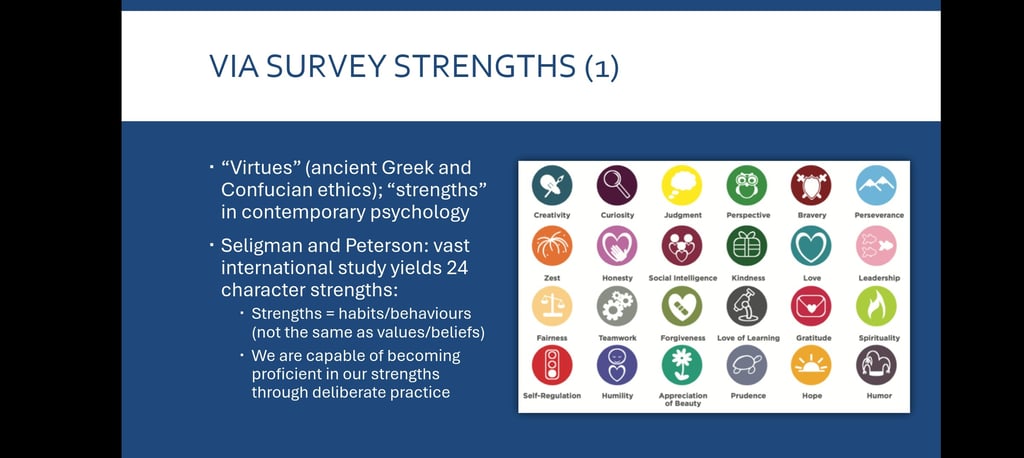
Introducing students to character strengths.